Published
14 minute read
By Shiwei Han, MD, PhD | Hairthetics Academy
In brief: After years of patients asking which shampoo they should use, I could not find a formula I felt comfortable consistently recommending. Drawing on my training in pharmaceutical science, medicine, research, and hair restoration, I developed the Hairthetics™ Hair Strengthening System as non-medicated cosmetic haircare designed for gentle cleansing and stronger-looking, more manageable hair.
There is a question I have been asked almost every day for as long as I have been practicing hair restoration medicine.
"Doctor, what shampoo do you recommend?"
For years, my honest answer was that I didn't have one.
Not because I didn't care, and not because the question wasn't important. It was important — more than most patients realize. Unlike many treatments that are used occasionally, shampoo is one of the few products almost everyone applies to their scalp several times every week, year after year. Small formulation decisions become repeated biological exposures over decades. What you apply to your scalp is part of the biological environment your hair follicles live in. The shampoo sitting in your shower is not separate from your hair health. It's part of it.
But I couldn't find a product I was genuinely comfortable putting my name behind. So for a long time, I just told patients to look for gentle formulas, avoid harsh sulfates, and minimize unnecessary fragrance if they had a sensitive scalp. General guidance. Not a real answer.
That bothered me.
Long before I became a physician, I was trained to think about formulation.
My undergraduate degree was in pharmaceutical science — the discipline that studies how formulations are designed, how ingredients interact, how concentration affects efficacy and safety, how stability is tested. It's a field that trains you to look at any product not just for what it claims to do, but for whether its formulation can actually support that claim.
One lesson from pharmaceutical science has stayed with me throughout my career: a product should never be judged by one ingredient alone. A formulation is a system. Every ingredient influences how the others perform. That way of thinking eventually shaped how I approached haircare.
That background also gave me a perspective that many physicians never have. I wasn't only interested in whether an ingredient might support scalp health. I was equally interested in how the entire formulation surrounding that ingredient would influence its performance, stability, and long-term tolerability.
The MD and PhD training that followed, and eventually the specialized focus on hair restoration, brought me into a field where that combination of backgrounds became unexpectedly useful, especially when patients began asking me which shampoo they should use.
Hair loss is more complex than it appears. It reflects a combination of genetics, hormones, inflammation, lifestyle, and the daily environment the scalp is exposed to. My patients are often highly motivated to do everything they can to improve their hair health, yet many tell me they have no idea how to evaluate a shampoo beyond the marketing claims on the bottle.
As my practice grew, I noticed something else.
Consumer awareness around ingredients had changed significantly. People were becoming more thoughtful about what they ate. They read food labels. They paid attention to what went into their skincare products. They looked for formulations that felt cleaner and better suited for long-term health.
Yet shampoo was often treated differently.
Most people use shampoo several times a week for decades, but very few look beyond the marketing claims on the front of the bottle. That never made sense to me. The scalp is living skin. Hair follicles are living organs. If we think carefully about what we eat and what we apply to our face, why should we approach the products we repeatedly apply to our scalp any differently?
When I looked carefully at what was actually available, what I found was a consistent pattern of compromise.
Some products were marketed specifically for people experiencing hair loss and included active ingredients with reasonable research behind them. But those ingredients were sitting inside formulations built on harsh surfactants, synthetic fragrances, or preservatives known to sensitize reactive scalps. The overall formula was not something I was comfortable recommending for regular use because it could leave the hair or scalp feeling dry or irritated, particularly for people with sensitive scalps.
Other products had made the opposite tradeoff. These products functioned primarily as cleansers — essentially washing the hair without doing much to support the scalp environment. No ingredients to support the scalp environment. No meaningful attention paid to what hair follicles actually need.
Neither category solved the problem. And the problem, as I understood it from treating patients every day, was this: the shampoo a patient uses is part of their overall scalp-care environment. A formula that leaves the scalp irritated or overly dry may make a consistent haircare routine harder to maintain. A gentler formula can support comfort and cosmetic hair quality, although shampoo is not a treatment for an underlying hair-loss disorder.
Hair restoration is a long game. Every part of the daily routine matters.
That realization reinforced something I had already been thinking for years: if I couldn't confidently recommend what was available, perhaps the answer wasn't to keep searching — it was to build it.
The decision to develop a formula came from accepting that the gap I was looking for wasn't being filled because it was genuinely difficult to fill.
It forced me to think through questions that most consumers — and even many physicians — never have to consider. How do you clean the scalp effectively without disrupting the barrier that keeps it healthy? Which active ingredients actually have meaningful evidence behind them, and at what concentration do they do anything at all? How much preservative is enough to ensure safety without exceeding what's necessary? How do you build a formula suitable for consistent use while allowing the ingredients inside it to work together as intended?
Each question became a line of inquiry I followed through the published literature, through formulation testing, and through user feedback. After an extended development process, that work became the Hairthetics™ Hair Strengthening Shampoo and Hair Nourishing Conditioner.
Developing a cleaner formulation was never about avoiding "chemicals." Everything in a shampoo is made of chemicals, including water. The question is whether each ingredient has a clear purpose, an appropriate concentration, and a favorable profile for long-term use. My goal was never to eliminate chemistry. It was to apply formulation science more thoughtfully.
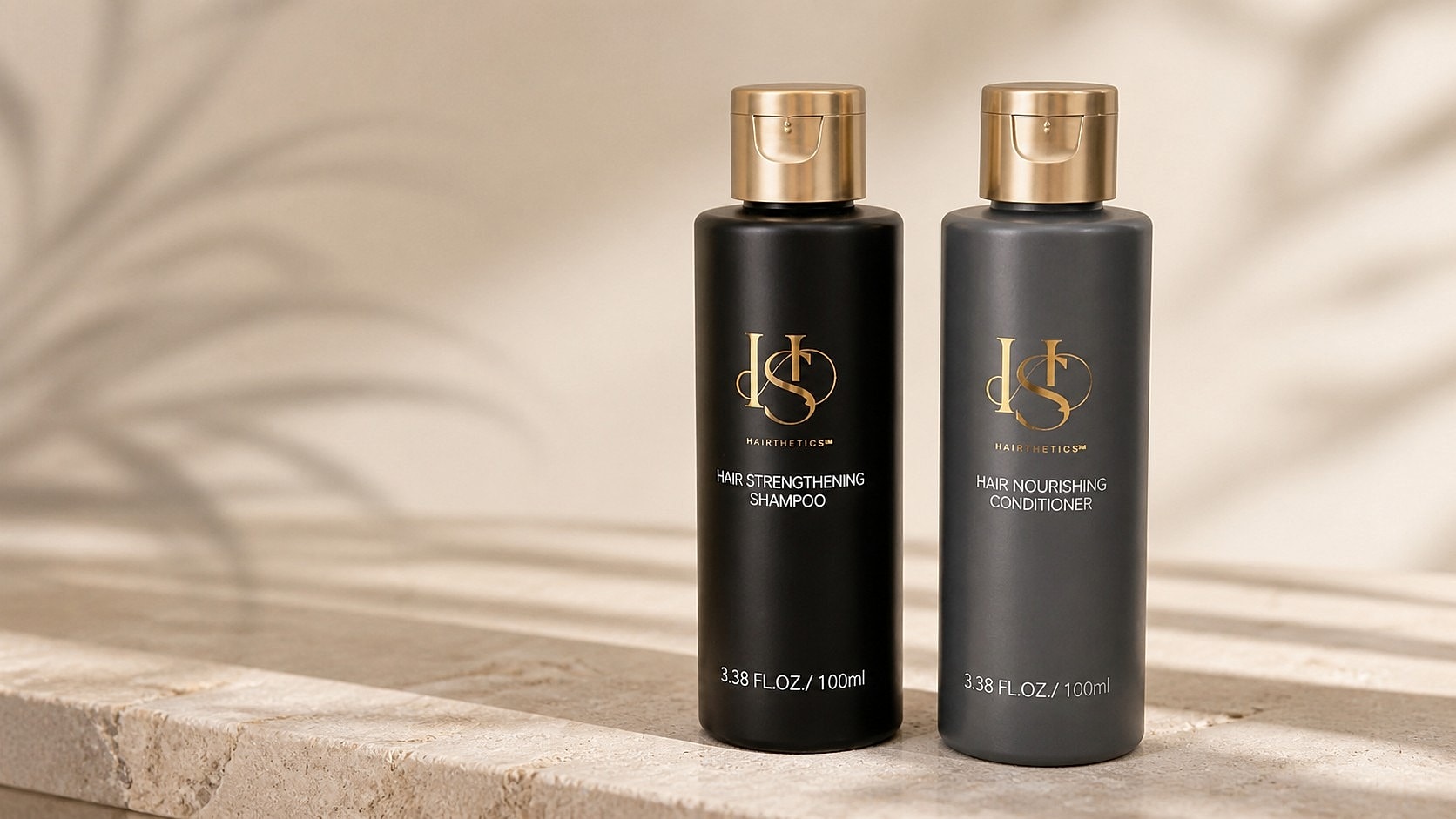
The result is two products that work as a complete system: the Hairthetics™ Hair Strengthening Shampoo and Hair Nourishing Conditioner.
Looking back, every major formulation decision ultimately came back to four principles. They weren't marketing goals — they were the standards I wanted every prototype to satisfy before I would recommend it to a patient.
"Most people have learned to check food labels. Some check skincare. Almost nobody checks shampoo."
I was seeing patients with sensitive or uncomfortable scalps who were using products containing multiple fragrances, stronger cleansing agents, or preservatives that may not suit every individual. Under trichoscopy, I also observed findings such as redness and buildup. Those findings can have many causes, but the recurring pattern made me look more carefully at how everyday haircare products affect comfort and the scalp environment. So the first principle was to treat the base formula — the excipients — as seriously as the active ingredients. Wherever possible, I selected ingredients with favorable safety profiles, with the majority of the excipients and functional ingredients falling within the EWG low-hazard categories (typically 0–2). For specialty cosmetic ingredients that are not individually rated by EWG, selection was based on published safety data, regulatory approval, and long-term cosmetic use. There is no synthetic fragrance. The scent comes from fruit essential oil and the ingredients' natural scent.
Harsh surfactants strip more natural oil than the scalp needs to lose. When that happens, the scalp can compensate by producing more sebum — which is why many people find their hair gets oily faster the longer they use an aggressive shampoo. To break that cycle, the cleansing system uses a combination of three mild surfactants, all derived from natural sources including coconut shell and sugar cane fibers. Based on our experiments, one mild surfactant alone does not clean thoroughly enough. Three together clean effectively without disrupting the scalp barrier. That balance became an important design principle throughout the entire formulation. Water-soluble collagen was added to help form a lightweight moisturizing film on the scalp surface and reduce moisture loss after cleansing. Allantoin serves a different role, helping soothe and support a more comfortable scalp environment.
During early product evaluation, one observation came up repeatedly and independently. Several people — including dermatology providers, physician colleagues, and professional hairdressers with decades of experience — commented that although the shampoo produced less foam than they expected, their scalp seemed to stay clean longer before becoming oily again. None of them had been told to look for that outcome. But it was entirely consistent with the biological principle the cleansing system had been designed around: when you stop stripping natural oils faster than the scalp can replace them, the scalp stops overcompensating. The rebound cycle slows. That's what the observation was reflecting.
Shampoos need preservatives — without them, bacteria and mold grow within days. But many commercial formulas use concentrations far above what is necessary, partly because they are filling large bottles and maximizing shelf life. After testing, we identified the minimum concentration that would pass required safety standards. What we arrived at is roughly one-tenth the concentration used in food industry standards — way less to what is in a jar of pickles. The bottle is food-grade, award-winning eco-friendly material, and both the bottle and cap materials were independently tested by SGS — the world's leading testing and certification organization — for heavy metals, showing non-detectable levels.
We also chose to manufacture the Hairthetics™ Haircare System in relatively small batches. Small-batch production allows tighter quality control, shorter time from manufacturing to the customer, and closer oversight of consistency between batches. Rather than producing extremely large inventories designed to sit in warehouses for long periods, our goal is to manufacture thoughtfully and replenish regularly. That philosophy aligns with how I approached the formulation itself: prioritize quality and consistency over mass production.
The system contains ten functional ingredients, each selected from peer-reviewed research and chosen to address a particular aspect of scalp health, hair-fiber health, or the hair cycle. But selecting an ingredient is only part of formulation science. The vehicle matters too.
Some ingredients are better suited to an aqueous shampoo system, while others are lipophilic and are more appropriately incorporated into a conditioner. Vitamin E is a good example: because it is lipid-soluble, the conditioner provides a more suitable vehicle for incorporating it into the haircare system.
That is one reason I developed the shampoo and conditioner together rather than treating the conditioner as an afterthought. They are complementary formulations with different physicochemical roles.
Beyond ingredient selection and vehicle design, concentration matters, and so does contact time. A rinse-off product with low concentrations and a brief rinse does very little regardless of what the label says. That is why the protocol was developed alongside the formula: five minutes for the shampoo, ten for the conditioner, used two to three times per week. Active ingredients require time to interact with the scalp — simply applying and immediately rinsing limits that opportunity regardless of what the formula contains. The contact time is what allows the active ingredients to do what they were included to do.
Dr. Han's Clinical Insight
"I hope that understanding the reasoning behind these decisions helps readers evaluate every shampoo — not just mine — with greater confidence and a more critical eye."
I didn't create Hairthetics™ because I wanted another product on the market. I created it because I finally wanted an answer I could give my patients with complete confidence. Now, when a patient asks me what shampoo I recommend, I have an answer. Not because I created a product — but because I spent years understanding why none of the existing ones were good enough, and then did the work to fill that gap. That is what the Hairthetics™ Hair Strengthening System is.
A haircare product is not a replacement for medical treatment when someone has genetic hair loss. But because it is used so frequently, I believe it should support — not work against — the overall health of the scalp.
That answer reflects not just a product, but years of clinical observation, pharmaceutical science, formulation work, and a commitment to recommending only what I genuinely believe serves my patients well.
A non-toxic shampoo avoids ingredients associated with irritation, hormone disruption, or long-term health concerns — things like synthetic fragrance, formaldehyde-releasing preservatives, sulfates such as SLS and SLES, parabens, and silicones. But "non-toxic" isn't a regulated term, so it's worth looking beyond the label claim. What actually matters is whether each ingredient — including the carriers and excipients, not just the actives — has a favorable safety profile for daily, long-term use. I evaluate this using published safety data and EWG hazard ratings.
The ones I consistently see causing problems in my clinic are sodium lauryl sulfate (SLS), synthetic fragrance, and formaldehyde-releasing preservatives like DMDM hydantoin. SLS strips natural oils aggressively and can trigger a rebound cycle where the scalp overproduces oil. Synthetic fragrance is one of the most common causes of scalp contact sensitivity — and companies aren't required to disclose the individual chemicals it contains. If your scalp is reactive, inflamed, or chronically itchy, those two are the first things I'd look at.
It means the entire formulation — not just the active ingredients — was selected with safety and biological purpose in mind. Most people now read food labels and skincare labels. Very few apply the same scrutiny to shampoo, even though they use it several times a week for decades. A clean ingredient shampoo is one where nothing is in the bottle just because it's cheap, convenient, or good for shelf life. Every ingredient has a reason to be there.
Not necessarily. “Sulfate-free” only means the product does not use particular sulfate surfactants such as SLS or SLES. What matters is the complete cleansing system, the concentration, and how the individual scalp and hair respond. People with dry, color-treated, or sensitive hair and scalps may prefer a milder cleansing system.
No. Cosmetic shampoo does not diagnose or treat the underlying causes of hair loss. Its role is cleansing and cosmetic scalp and hair care. A gentle formula may help the scalp feel more comfortable and hair look and feel healthier, but persistent shedding, thinning, itching, or inflammation should be evaluated by a qualified medical professional.
EWG Skin Deep rates cosmetic ingredients from 0 to 10 based on available hazard data. A rating of 0–2 reflects the lowest level of concern. It's a useful reference, but not a complete picture — some specialty cosmetic ingredients aren't individually rated by EWG. When I formulate, I use EWG as one input alongside published safety data, regulatory approval, and evidence of safe long-term cosmetic use.
Two to three times per week is what I recommend for the Hairthetics™ system. But the frequency is less important than the contact time. For the Hairthetics™ system, the suggested routine is a five-minute shampoo massage followed by ten minutes with the conditioner. This is the use protocol the cosmetic formula was designed around.