Published
10 minute read
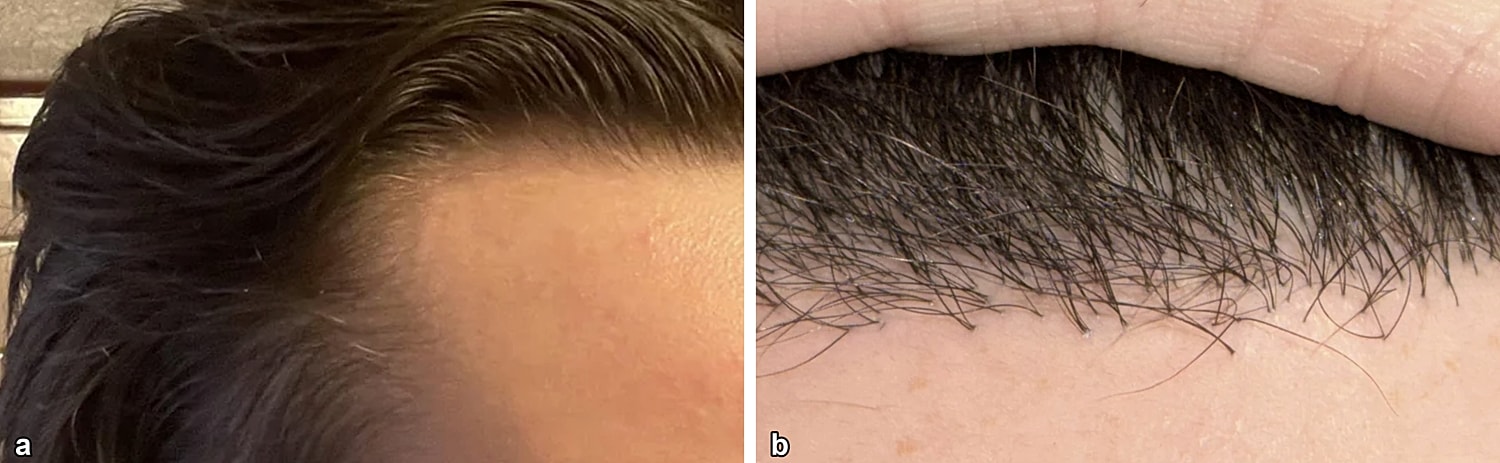
You can usually spot a bad hair transplant before you even know what you're looking at. Something just feels off. The hairline sits a little too straight. The front looks too thick. The hair points the wrong way when the wind blows.
Here's the thing: it's almost never about the surgery failing. Most of the time, every graft survived and grew exactly as planned. The problem is that the plan itself didn't match how real hair actually grows.
If you're researching a hair transplant, "will it look fake" is probably your biggest fear. And it's a reasonable one. You've seen the photos online — the doll-hair hairlines, the corn-row patches, the front that looks painted on. That look has a name in the industry: pluggy. It comes from the old plug era of hair restoration, and even though the technology has moved way past that, the mistakes that cause it are still being made today, just with newer tools.
Knowing what actually separates a natural result from an obvious one lets you ask the right questions before you commit to a surgeon, a technique, or a hairline design. That's the goal of this article.
Real hair isn't uniform. It doesn't grow straight up, it doesn't come out of the scalp in one direction, and it isn't the same thickness from your forehead to your crown. A transplant only looks natural when it copies that variation, not when it "fills in" the bald area.
A few things matter more than people expect:
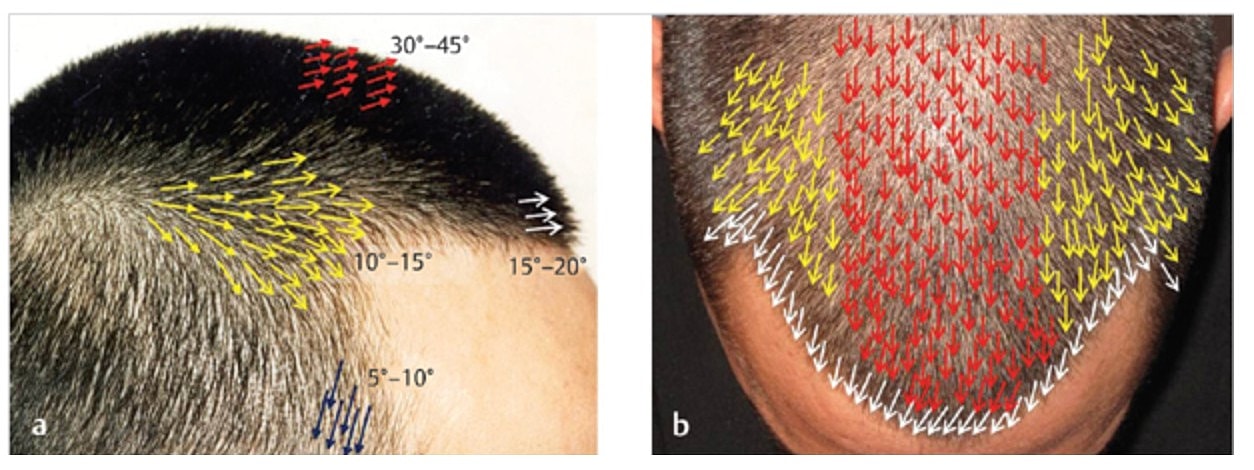
Angle. Hair doesn't sit at 90 degrees to your scalp. Along the front hairline, native hair usually exits at a low, forward angle, often somewhere in the 10 to 20 degree range. Move back toward the mid-scalp and that angle steepens toward 30 to 45 degrees. Plant grafts too upright at the hairline and they read as artificial even from across a room, because that's not how hair behaves there.
Direction. This is different from angle. Angle is the tilt; direction is the compass heading. Hair at the hairline generally points forward and slightly to the side, following a pattern that curves around the head. Get the angle right but the direction wrong, and hair will part strangely or stick out at odd moments.
Density gradient. Nobody's hairline is a solid wall of hair. The first row or two is soft and sparse on purpose. Density should build gradually as you move back from the hairline into the mid-scalp, not jump straight to full thickness. A hairline transplanted at full density looks like a wig line, not a hairline.
Graft type by zone. Natural hairlines are made almost entirely of single hairs at the very front edge. Two- and three-hair follicular units belong further back, where they add bulk and coverage. When multi-hair grafts get placed right at the leading edge, you get visible tufts with gaps between them — the classic pluggy look, even with modern FUE.
The crown. Hair at the crown spirals out from a central point, called a whorl. Some people have two or even three whorls. This is one of the hardest areas to get right because there's no straight-line pattern to copy — every whorl is planned individually.
None of this is exotic knowledge. It's basic hair biology. But it takes real attention to translate it into thousands of individual graft placements, one at a time, for hours.
Most artificial-looking results trace back to a short list of repeatable mistakes:
Any one of these can be the difference between a result that disappears into your natural hair and one that gets noticed.
At Hairthetics, Dr. Han personally leads the design of every recipient site — the tiny incisions that set the angle, direction, and density for each graft. He works closely with his highly trained team, but he doesn't hand this part off. It's the step that decides how natural the result looks, so it stays under his direct oversight from planning through execution. Each graft is then inspected, sorted by hair count and caliber, and matched to the site where it'll look most natural, from extraction through implantation.
Before any extraction happens, we map the hairline and density plan using AI-assisted imaging, so the design accounts for your existing hair pattern, your face shape, and how your hairline is likely to change as you age. Recipient sites for the transition zone at the very front and around the temples are cut for single-hair grafts, where they do the most work creating a soft, irregular edge. Sites further back are designed for denser, multi-hair grafts, where real hair is naturally fuller.
We also use techniques like Slim FUE and No-Shave InvisiGraft, which reduce trauma to both donor and recipient sites. Less trauma means better graft survival and a cleaner canvas to work with, which supports a more precise, natural design. For patients with curly or Afro-textured hair, extraction and placement are adjusted specifically to preserve the natural curl pattern through the whole process — a detail that gets missed often when a technique built for straight hair gets applied without adjustment.
None of this is about a fancier tool. It's about treating hairline design as its own discipline, not an afterthought to the surgery.
"The number one thing I tell patients is that a natural hairline is supposed to look a little imperfect. If it looks too clean, too straight, too dense right at the edge, that's actually the sign something's wrong. I spend more time planning the first two rows of a hairline than almost anything else in the procedure, because that's the part people are looking at when they look at you. The rest of the head just needs to be full. The front needs to be right."
-Dr. Shiwei Han, MD, PhD, Harvard-trained surgeon-scientist and founder of Hairthetics
Can a "pluggy" hair transplant be fixed?
In most cases, yes. Repair usually involves a combination of removing or redistributing poorly placed grafts and adding single-hair grafts around the existing ones to soften the line. It takes longer and needs more planning than an original procedure, but a pluggy result is rarely permanent.
Is FUE always more natural-looking than FUT (strip surgery)?
Not automatically. FUE and FUT are both extraction methods, and either can produce natural or artificial results depending on how the grafts are placed. The placement — angle, direction, density, and hairline design — determines the look, not the harvesting method alone.
How long does it take to know if a hair transplant looks natural?
New growth typically starts around month four, with density building through months six to nine. Final results, including how the hairline settles and matures, are usually clear by around twelve months.
Does a more expensive clinic guarantee a more natural result?
Generally, yes, price tends to track value here. A technician-led, high-volume clinic and a physician-led boutique practice have very different cost structures, and a well-trained surgeon with real credentials can't realistically charge the same price as a low-cost hair mill and still deliver the same level of care. At Hairthetics, for example, we use laughing gas before the local anesthesia and nerve block, so patients don't feel pain even from the numbing injection itself. That machine and the gas cost money most clinics skip. We also provide hands-on post-op day 1 wound care and a post-op day 2 hair wash, which very few clinics offer at all. All of that is part of what you're paying for. Rather than asking whether a clinic is "expensive," ask what's actually included in the price: who performs the surgery, how pain is managed, and what aftercare looks like in the first days after your procedure.
Why do some transplants look worse years later?
Two things usually explain this. First, native hair loss can keep progressing around a transplant that was designed only for the hairline you had at the time of surgery, so a hairline planned without accounting for future thinning can end up looking isolated or "island-like" as the surrounding hair recedes further. Second, the hair you didn't transplant is still under attack from the same genetic and hormonal process that caused your hair loss in the first place. Without ongoing maintenance, like finasteride, minoxidil, or other medical therapy, that native hair can keep thinning around your results, which changes how the whole transplant reads over time. A good long-term plan treats the transplant and the surrounding native hair as one picture, not two separate problems.
- Artificial-looking transplants are almost always a design problem, not a graft-survival problem.
- Angle, direction, density gradient, and graft type all have to match your natural hair pattern zone by zone.
- Single-hair grafts belong at the hairline's leading edge; multi-hair grafts belong further back.
- A hairline that looks too straight or too dense right at the front is the biggest tell of a poor design.
- How your recipient sites are designed matters as much as which technique your clinic uses.
- A natural transplant needs a long-term maintenance plan, not just a good day of surgery.
If you're planning a hair transplant and want a design built around your face, your hair pattern, and how you'll age, schedule a private consultation with Dr. Han.
---
Dr. Shiwei Han is a Harvard-trained surgeon-scientist and founder of Hairthetics in Hallandale Beach, Florida. His clinical interests include FUE hair transplantation, regenerative hair restoration, minimally invasive ear harmonization surgery, and evidence-based aesthetic medicine. He has authored peer-reviewed scientific publications and regularly presents research at national and international medical conferences. View his publications on Google Scholar.