Published
18 minute read
Over the years performing cosmetic procedures, I kept noticing the same pattern repeat itself.
Patients weren't rejecting ear correction because they didn't want better-looking ears. They were rejecting the surgery.
The conversations almost always went the same way. A patient would mention their ears — usually in passing, as though they'd learned not to bring it up too directly. I'd ask if they'd looked into doing something about it. And then came the list.
The fear of general anesthesia. What if something went wrong? What if they didn't wake up the same? It sounds dramatic, but this is what people actually think about.
Taking weeks off work. Two to four weeks of visible recovery — bandages, swelling, not being able to explain it to colleagues or clients. For a lot of people, that's simply not possible.
The scars. Even small ones. Even ones hidden behind the ear. The idea of a permanent surgical scar made people hesitate in a way that surprised me at first, but ultimately made complete sense. For something they described as "just my ears," a visible scar felt like a bigger commitment than the problem warranted.
"It's just my ears." That phrase came up more than any other. Not because they didn't care — they clearly did. But because the gap between how much it bothered them and what was required to fix it was just too wide. So they talked themselves out of it.
I started wondering: what if we could keep the goal while removing much of what patients feared?
That question is where this technique came from.
Each concern shaped a specific part of the approach: local anesthesia instead of general anesthesia, a small hidden access point instead of a longer incision, limited dissection instead of wider exposure, cartilage preservation whenever possible, and permanent internal sutures intended to maintain the correction. The goal was not to make otoplasty less serious. It was to make the path to a permanent result less invasive, more manageable, and better aligned with what many patients were asking for.
Prominent ears generally result from excessive projection of the auricle from the side of the head, often associated with an underdeveloped antihelical fold, an enlarged or deep conchal bowl, or both. They are one of the most common aesthetic concerns I see. They affect somewhere between 5% and 10% of the population. And despite how common they are, conventional otoplasty still commonly involves many of the same elements patients have worried about for years: a more extensive surgical approach, visible early recovery, and, in some cases, sedation or general anesthesia.
Traditional otoplasty remains an excellent operation for many patients and has helped countless people over the years. But many of today's patients have different priorities — they want a permanent correction without general anesthesia, extensive tissue dissection, or a prolonged visible recovery. That is not a criticism of traditional otoplasty. It is part of the continued evolution toward more individualized and less invasive surgical options.
So what happens to patients who are unwilling or unable to undergo a more extensive open procedure? Many people simply adapt. They wear their hair differently, avoid certain hairstyles, or convince themselves the problem isn't worth solving.
But it does matter. The ears are one of the most visible parts of the face. When they feel out of proportion, it can affect how someone carries themselves — how they style their hair, how they pose in photos, how much they think about their appearance on any given day.
For appropriately selected patients, a minimally invasive approach changes the conversation. It makes ear correction feel achievable rather than overwhelming.
My philosophy has never been "ear pinning."
It's facial harmony.
People don't look at ears in isolation. They see a face — the hair, the jawline, the profile, the overall proportion. When you assess ears as a standalone structure, you risk correcting the wrong thing, or overcorrecting it, or ending up with a result that looks technically accurate but somehow still feels off.
A successful procedure shouldn't make people notice your ears. It should make them stop noticing them.
That's a different goal than simply pulling the ears backward. And it requires a different way of thinking about the assessment, the planning, and the execution.
When I evaluate a patient's ears, I'm not just looking at millimeters of protrusion. I'm looking at where the ears sit within the full frame of the face — the oval, the hairline, the jaw, the temples. Because what looks prominent on one face might look perfectly proportionate on another, depending on everything surrounding it.
That's what harmony means. Not symmetry. Not a number on a ruler. A result that fits.
I intentionally don't use the term "ear pinning" to describe what I do.
Because pinning implies a single goal: pull the ears backward. That's it.
But that's not my goal. My goal is harmony — adjusting the ears so they sit naturally within the proportions of the face. Sometimes that means moving them back. Sometimes it means reshaping a specific structure. Sometimes it means addressing asymmetry between the two ears rather than just correcting protrusion. Sometimes all three.
The name "Ear Harmonization" isn't just a label I prefer for this philosophy. It describes a different intent. And that intent shapes every decision I make during a procedure — where I access, how much I adjust, what I leave alone.
At Hairthetics, I perform Minimally Invasive Otoplasty using what I call an Ear Harmonization philosophy — one that prioritizes facial balance, natural contours, and individualized correction rather than simply pulling the ears backward.
When correction focuses only on pulling the ears backward, the result can appear overly flat or overcorrected. Ear Harmonization instead considers projection, contour, asymmetry, and the relationship of the ears to the entire face.
To understand why the technique works, you need to understand what actually causes ears to protrude.
In most cases, it comes down to two things:
1. Underdeveloped antihelical fold. The antihelix is the curved ridge on the inner part of your ear. When it doesn't form properly, the top of the ear doesn't fold back the way it should. The ear ends up facing more outward than inward.
2. A deep or oversized conchal bowl. The concha is the cup-shaped part of the ear closest to the ear canal. When it's too deep, it physically pushes the ear away from the head.
These aren't random problems — they're structural. The cartilage may lack a well-defined fold, project excessively from the conchal region, or combine both features in varying degrees. Traditional surgery addresses these structural issues through cartilage reshaping, suturing, and, in some cases, cartilage excision. Depending on the patient and the surgeon's approach, it may be performed under local anesthesia, sedation, or general anesthesia.
My approach uses a small hidden access incision, limited dissection, targeted cartilage scoring, and permanent buried sutures to reshape and reposition the ear under local anesthesia. The goal is to reduce tissue disruption while still creating a durable structural correction.
The underlying anatomy is the same. The goal is the same. The path to get there is different.
My training as both a surgeon and scientist shapes how I approach every procedure. My PhD research and published work and my time at Harvard Medical School and Massachusetts General Hospital taught me to question assumptions, examine underlying mechanisms, and look for ways to achieve an objective with greater precision and less unnecessary disruption.
Rather than accepting that "this is how it's always been done," I ask whether the same result can be achieved with less trauma, less downtime, and a better patient experience. Research training makes you skeptical of received wisdom. It makes you ask whether the evidence actually supports the current standard — and what the alternatives look like.
That's how I approach ear correction. Not as a fixed protocol, but as a problem worth thinking carefully about. What does this specific patient need? What structures are actually responsible for the protrusion? What's the most precise, least disruptive way to address it?
That mindset is what led me to the approach I use now. You can read more about how Hairthetics came to be in an earlier interview where I talked through the founding story.
Every Minimally Invasive Otoplasty procedure I perform follows five principles:
1. Preserve natural anatomy whenever possible. The goal is correction, not reconstruction. I work with the ear's existing structure, not against it.
2. Never overcorrect. Ears set back too far look pinned — flat against the skull and unnatural. A few millimeters of intentional dimension makes a result look human.
3. Treat each ear independently. Almost everyone's ears differ from each other. Treating them identically often produces a result that looks identical but feels wrong. Natural balance, not mathematical symmetry.
4. Design around the entire face — not just the ears. Ear position interacts with the jaw, hairline, temples, and overall facial oval. Every adjustment is made in the context of the whole picture.
5. Minimize trauma without compromising long-term stability. Less invasive doesn't mean less precise. It means finding the most direct path to a result that holds.
Several problems can arise when ear correction is approached too narrowly — or when patients believe their only choices are a traditional operation or no treatment at all.
Treating it as an all-or-nothing choice. Most people assume there are only two options: do nothing, or undergo a more extensive traditional operation. That gap is where many patients fall through. A minimally invasive surgical approach isn't the right fit for everyone, but it is an option more patients should know exists.
Overcorrection. This is one of the most common aesthetic mistakes in ear pinning procedures. When ears are set back too far, they look pinned — flat against the skull, unnatural. The goal isn't to make ears invisible. It's to bring them into proportion with the face. Ears still need to have dimension.
Ignoring asymmetry. Almost everyone's ears are slightly different from each other. A good approach accounts for that. Setting both ears to the exact same angle often produces a result that looks off, because the underlying anatomy is different on each side.
Focusing only on the ear, not the whole picture. Ear position interacts with the jaw, the hairline, and the overall oval of the face. An ear that looks prominent on one face might look perfectly fine on another, depending on the proportions. Any assessment needs to factor in the full frame.
Underestimating patient anxiety. A thoughtful consultation should explore not only what correction is anatomically possible, but also which approach best fits the patient's concerns, recovery needs, and tolerance for anesthesia.
When a patient comes in about their ears, I don't start with technique. I start with what's actually bothering them.
Is it the angle? The height? Asymmetry? Are they bothered by both ears or just one? Have they always been self-conscious about it, or is this something they've noticed more recently? What have they tried — if anything?
From there, I do a full structural assessment. I look at the antihelical fold, the depth of the concha, the position relative to the face, and the degree of protrusion on each side. I take measurements and photos. I want to understand exactly what's happening anatomically before we talk about anything.
Then we talk through options honestly. Minimally invasive otoplasty may be appropriate for patients who:
It's not the right choice for severe cases, or for patients where the anatomy requires more significant structural change than a minimally invasive approach can achieve.
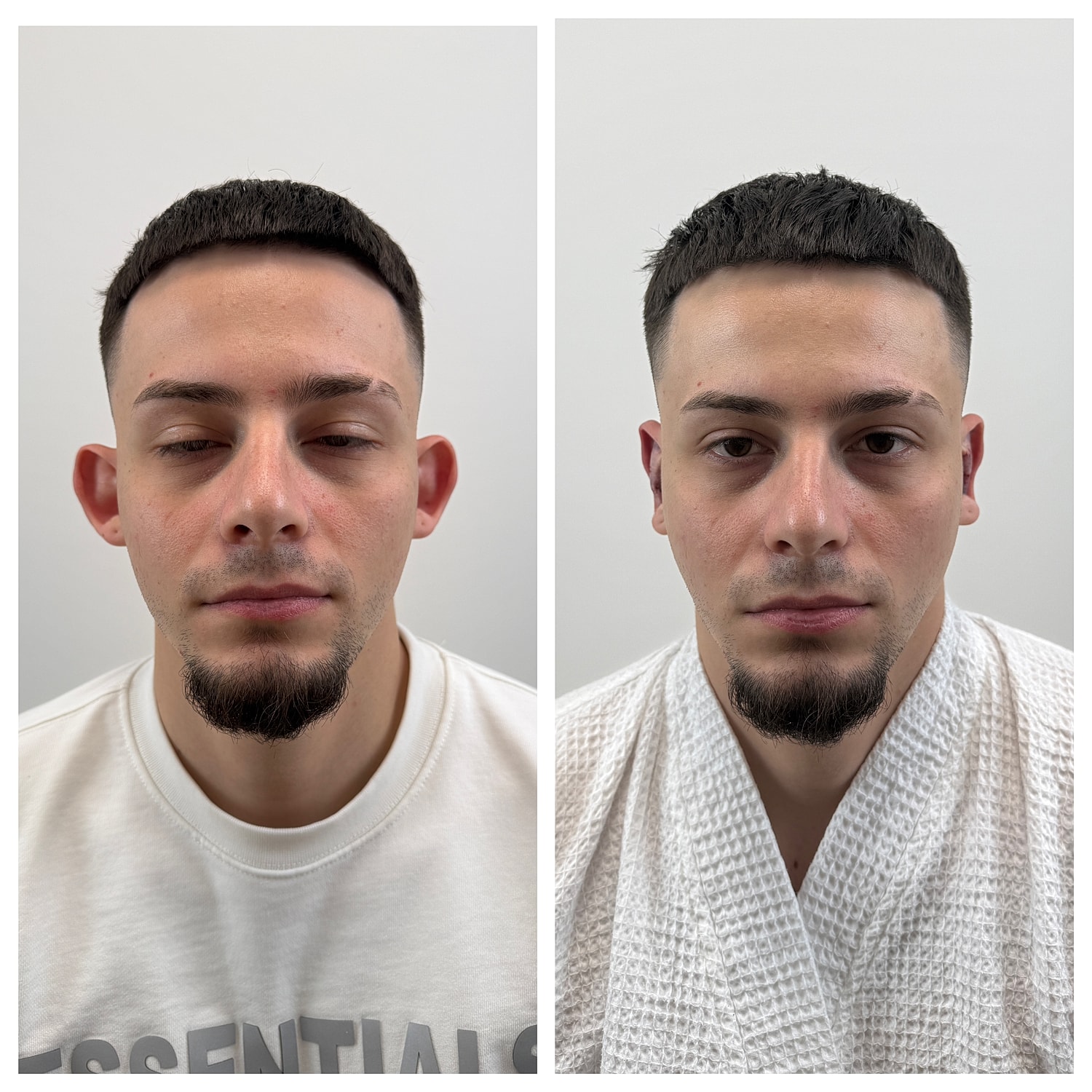
The procedure itself is done under local anesthesia. The access points are small. Patients leave the office the same day. A protective headband is worn only at night while sleeping for approximately four weeks, and most patients are back to normal daily activities within a few days.
Performing the procedure under local anesthesia also allows the patient to remain involved in the design process. Once the ears have been repositioned, we assess the new position together. The patient can look in the mirror, share how the new ear position looks to them, and participate in decisions about whether additional adjustment is needed. I can then refine the position and reassess it with the patient before the procedure is completed.
That collaboration is important because ear correction is not simply about achieving a predetermined measurement. It is about finding a position that looks natural within the patient's face and also feels right to the person who will live with the result. Local anesthesia allows the correction to be evaluated in real time, with the patient's natural facial position preserved and their perspective included in the final design.
If a family member had prominent ears, suitable anatomy, and wanted correction, this is the approach I would ask them to consider first.
Not because it's newer. Not because it's trendy. But because, for appropriately selected patients, it offers the combination I value most: a natural appearance, permanent structural correction, local anesthesia, and a faster recovery with less tissue disruption than a more extensive open procedure.
I've seen what general anesthesia anxiety does to people. I've seen patients delay something for years because the only path available felt too steep. The minimally invasive approach isn't a shortcut. Done well, it's a precision tool for the right candidates.
And when someone is the right candidate, I'd rather start there.
As I have continued performing and refining this procedure, the thing that strikes me most is how much a small structural change can mean to someone.
The ear corrections I do aren't dramatic. I'm not rebuilding anatomy from scratch. I'm adjusting proportion by a few millimeters. But the shift in how patients carry themselves afterward — the way they wear their hair, how they look in photos, how they talk about themselves — it's consistently significant.
The minimally invasive approach matters to me because it lowers the barrier. It gives people who are not ready for a more extensive open procedure — or who prefer to avoid general anesthesia and a prolonged recovery — a genuine surgical option.
My hope has never been to create "perfect ears."
My hope is much simpler.
That one day a patient wakes up, ties their hair back without thinking, catches their reflection in the mirror, and realizes they haven't thought about their ears in months.
No conscious decision to wear their hair a certain way. No avoiding photos taken from the wrong angle. No small background awareness that something is off.
Just their face, looking like theirs.
That's when I know we've achieved what ear correction was always supposed to achieve — not perfect ears, but ears that simply belong to the face.
Today, patients travel to Hairthetics from across Florida and other parts of the United States — including Tampa, Sarasota, Atlanta, Boston, and Texas — to explore whether Minimally Invasive Otoplasty is the right approach for them. For patients considering ear correction, the first step is an individualized consultation to determine whether their anatomy is suitable for this approach.
What is Minimally Invasive Otoplasty at Hairthetics? Minimally Invasive Otoplasty is a procedure designed to reposition or reshape prominent ears to bring them into better proportion with the rest of the face. At Hairthetics, it is performed using an Ear Harmonization philosophy — a guiding approach that prioritizes facial balance, natural contours, and individualized correction — and can be done under local anesthesia, without the full surgical setup of traditional otoplasty.
How is this different from traditional ear pinning (otoplasty)? Traditional otoplasty may address these structures through a longer incision, wider cartilage exposure, cartilage scoring or excision, and internal sutures. Depending on the patient and the extent of correction, it may be performed under local anesthesia, sedation, or general anesthesia. For appropriately selected patients, my minimally invasive approach is designed to correct the same underlying features — such as an underdeveloped antihelical fold or conchal prominence — through smaller access points and more limited tissue dissection.
Who is a good candidate for Minimally Invasive Otoplasty? Good candidates typically have mild to moderate ear protrusion, are in good general health, prefer to avoid general anesthesia, and have realistic expectations about what the procedure can achieve. Patients with severe protrusion or significant structural asymmetry may still need traditional surgery for the best result.
Is the procedure painful? Local anesthesia is used to numb the treatment area. Patients may feel pressure or movement, but they should not feel sharp pain; additional anesthetic can be given if needed. Soreness and tenderness are expected during the first several days and are usually manageable with over-the-counter pain medications.
How long is the recovery? Patients leave the office the same day. Initial swelling and tenderness are most noticeable during the first several days. A protective headband is worn only at night while sleeping for approximately four weeks. Most patients return to desk work and normal daily activity within a few days, with physical exercise and activities that could impact the ears restricted for a few weeks.
Can Minimally Invasive Otoplasty fix asymmetrical ears? Yes — in fact, addressing asymmetry is a standard part of the procedure. Each ear is assessed and treated independently. The goal is natural-looking balance, not a mathematically identical result on both sides.
Are the results permanent? The procedure is intended to create a permanent structural correction. The ears are repositioned using permanent, non-absorbable nylon sutures together with cartilage reshaping to maintain the new position. As with any otoplasty technique, individual healing varies, and partial recurrence can occur after healing, trauma, or suture-related changes. The procedure is designed as a permanent correction, not a temporary treatment.
How young can a patient be for this procedure? Candidacy depends on ear development, cartilage characteristics, the degree of correction needed, the patient's maturity, and the ability to cooperate with the procedure and postoperative care. For minors, the decision must involve the parent or guardian and requires an individualized consultation. Not every younger patient is an appropriate candidate for a minimally invasive approach.
What is the Ear Harmonization philosophy, and how does it differ from traditional ear pinning? "Ear pinning" typically refers to the surgical correction of prominent ears, with the primary goal of pulling the ears closer to the head. The Ear Harmonization philosophy is the guiding design approach I use at Hairthetics — one that considers the ears in the context of the entire face: projection, contour, asymmetry, and overall proportion. The procedure I perform is called Minimally Invasive Otoplasty. The philosophy behind it is Ear Harmonization.
Does insurance cover Minimally Invasive Otoplasty? Most insurance plans classify ear reshaping as cosmetic. In cases where ear deformity is congenital or affecting a child's development, there may be some coverage — but this varies significantly by plan. We're happy to help you understand your options during a consultation.
Dr. Han is the founder of Hairthetics Academy and a surgeon whose practice focuses on hair restoration, minimally invasive otoplasty, and regenerative aesthetics. If you're considering ear correction and want to understand your options, book a consultation to discuss what approach makes sense for you.