
Hair Transplant
Published
3 minute read
"Should I add PRP, or is it just an expensive add-on?"
That's one of the most common questions patients ask before a hair transplant.
Current research — including a 2025 systematic review of 217 patients across three controlled trials — suggests PRP can improve graft survival, accelerate regrowth, and increase hair density when prepared and used correctly. At Hairthetics, we use a validated Angel® PRP protocol that routinely achieves 12–17× platelet concentration, substantially higher than many standard PRP systems.
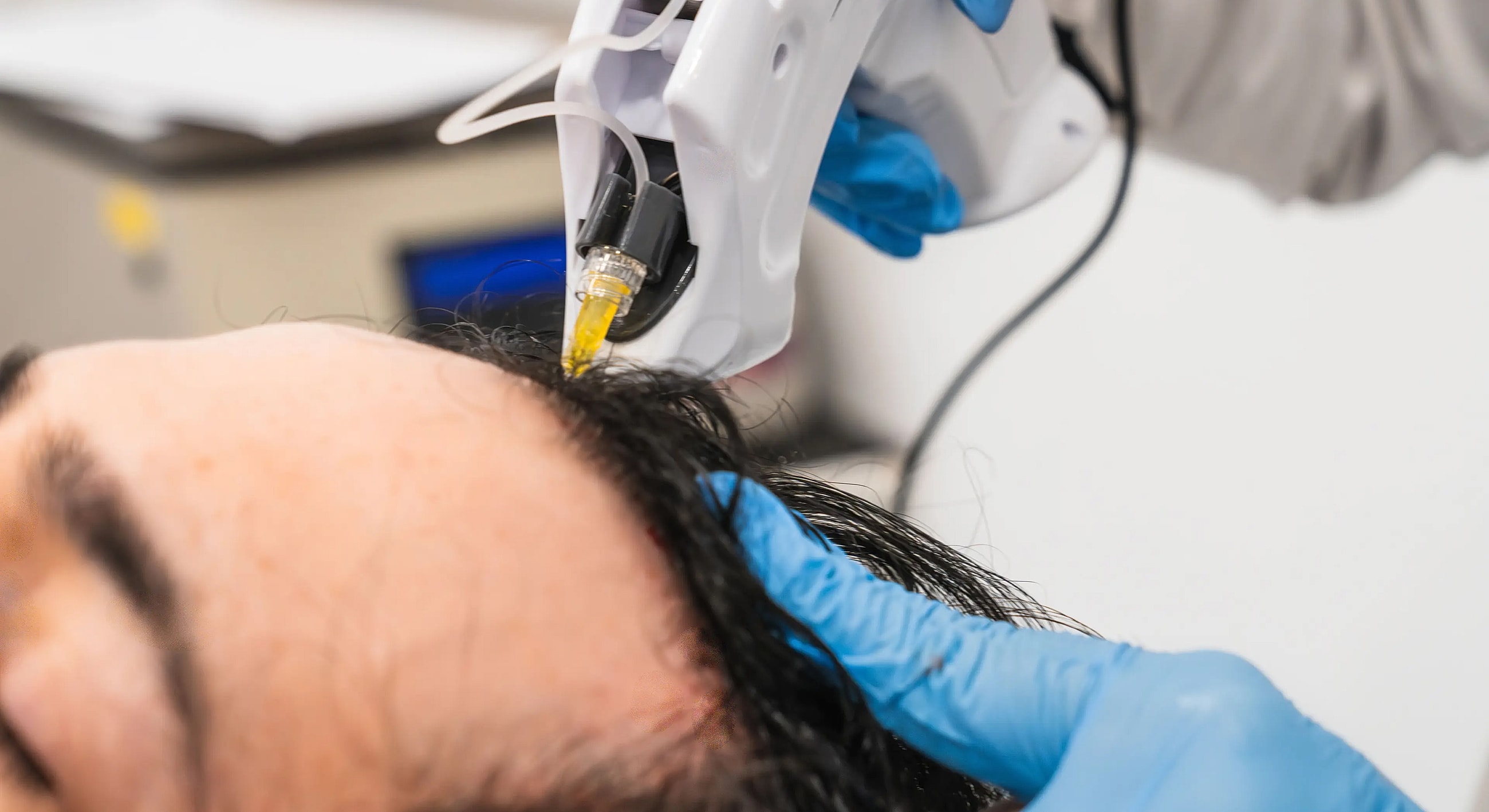
So what exactly is PRP? Platelet-rich plasma (PRP) is a concentrated portion of your own blood that contains high levels of healing growth factors. When used alongside hair transplantation, studies suggest it can improve graft survival, speed early regrowth, and increase hair density.
Here's what the evidence actually shows, and how we approach it at Hairthetics.
PRP currently has some of the strongest clinical evidence among all adjunct therapies used in hair transplantation. Some recent studies provide the strongest evidence to date. Taken together, they suggest PRP is no longer considered an experimental add-on, but an evidence-supported adjunct to modern hair transplantation.
2025 Systematic Review — 217 Patients, Three Controlled Trials
A systematic review published in Cureus in 2025 analyzed three prospective controlled trials. Across all three studies, adding PRP to hair transplantation was associated with increased hair density, improved follicle survival, and earlier onset of hair growth compared with transplantation alone. The authors concluded that PRP offers genuine clinical benefit as an adjunct — while noting that standardized preparation protocols still need to be established across clinics.
2025 RCT — PRP as a Graft Storage Solution
A randomized controlled trial published in the Journal of the Egyptian Women's Dermatologic Society assigned 60 men with androgenetic alopecia (grades III–VI) to two groups during FUE: grafts stored in PRP versus grafts stored in normal saline. At 12 weeks:
Why graft storage matters Hair follicles temporarily lose their blood supply once they're extracted. Reducing dehydration and cellular stress during this period is one of the most important factors influencing graft survival. This study suggests that storing grafts in PRP rather than saline may better protect follicles during this vulnerable phase.
One honest caveat: PRP preparation quality varies enormously between clinics. Unfortunately, there is currently no universal PRP standard across clinics. Platelet concentration, centrifuge protocol, and whether the PRP is validated before injection all affect the clinical outcome. This is why some clinics report strong results and others see little difference.
Hair Transplant Alone | Hair Transplant + PRP | |
|---|---|---|
| Graft survival | Standard | Higher graft survival reported in three RCTs |
| Hair Transplant Recovery | Normal healing timeline | Faster healing, reduced post-op inflammation |
| Early Hair Growth | Typically 6 months | Earlier regrowth reported; some patients notice results by 4 months |
| Hair density | Depends on graft count | Increased density reported in all reviewed studies |
| Native hair | No stimulation | May improve surrounding thinning hairs |
| Shedding phase | Standard | Evidence suggests shorter shedding phase |
Published
9 minute read
PRP isn't a single treatment. There are three windows where it can be applied, and they serve different purposes.
This is where the strongest evidence sits. Keeping extracted grafts in a PRP solution during the implantation phase — rather than normal saline — reduces stress on follicles while they're outside the body. The 2025 RCT showed a dramatic difference in graft coarseness and multi-hair density at 12 weeks.
Some surgeons also inject PRP into recipient sites immediately after implantation to give grafts a better environment from day one.
Some patients get 2–3 PRP sessions before their transplant, starting 2–3 months out. The goal is to improve scalp vascularization, strengthen existing thinning hairs, and create a healthier environment for incoming grafts. For patients with a compromised scalp or significant surrounding thinning, this prep phase can matter.
This is the most common post-operative approach. Most protocols recommend starting around 3–4 weeks after surgery. A standard schedule:
Hair Transplant Recovery Timeline With PRP
Surgery day → PRP during graft preservation
↓
Week 4 → First post-op PRP session
↓
Month 3 → Second PRP session
↓
Month 6 → Third PRP session
↓
Every 6–12 months → Maintenance
Some patients begin noticing visible regrowth as early as 4 months, although individual results vary and full results still take around 12 months.
PRP stands for Platelet-Rich Plasma. Your blood contains platelets — tiny cell fragments that rush to injuries and release proteins that signal the body to heal. These proteins are called growth factors. The relevant ones for hair restoration are:
Depending on the preparation system, PRP may concentrate platelets several-fold above baseline. At Hairthetics, our Angel® protocol routinely measures approximately 12–17× baseline platelet concentration — a level that makes a clinically meaningful difference in the growth factor load delivered to the scalp.
Not all PRP is the same. One clinic may draw 10–20 mL of blood and produce a relatively low platelet concentration. Another may never measure how concentrated the final product actually is.
At Hairthetics, we use the Angel® PRP System, one of the most validated PRP platforms available. Here's what that means in practice:
This is meaningfully different from standard PRP. The growth factor concentration in a well-prepared Angel PRP session can be substantially higher than what a basic single-spin centrifuge produces from a small blood draw. That higher concentration is believed to contribute to better biological activity and may help explain the improved clinical outcomes reported across multiple studies.
Using PRP too early post-op. Injecting into a scalp still actively healing in the first 1–2 weeks can disrupt graft anchoring. We wait at least 3–4 weeks before the first post-operative session.
Settling for low-quality preparation. If a clinic draws only 10–20 mL of blood, runs one centrifuge cycle, and injects without measuring the final concentration, the growth factor load may be too low to make a meaningful clinical difference. Ask any clinic: what system do you use? How much blood do you process? Do you measure platelet counts?
Thinking PRP replaces the transplant. PRP stimulates existing follicles. It cannot create new hair where the follicle is gone. For Norwood 4+ hair loss, PRP alone won't restore density — but used alongside a well-planned transplant, it extends and enhances the result.
Expecting PRP to correct a poorly done transplant. It supports good work. It doesn't fix bad placement, wrong angles, or insufficient graft density.
We don't recommend PRP to every patient because not every patient needs it. For most of our FUE patients, we incorporate intraoperative PRP as part of the surgical protocol because we believe this is where the evidence is strongest — keeping grafts in a validated PRP solution during surgery costs the patient no additional recovery time and the data supports it.
For post-operative PRP, we recommend it for patients who:
Dr. Han reviews each patient's scalp health, donor quality, and existing hair before making a recommendation. PRP is one part of the plan — not the whole plan.
If you're not sure whether you need PRP alone, a hair transplant, or both, read our guide: PRP for Hair Loss: Who Is It Best For?
"One thing I've learned over years of performing FUE is that transplanted grafts are most vulnerable while they're outside the body. From the moment a follicle is extracted to the moment it's implanted, it's under stress. That's why I pay close attention to graft preservation throughout every procedure.
Storing grafts in a patient's plasma has become a routine part of our surgical protocol because both our own clinical observations and the published research suggest it gives follicles the best chance to survive and grow. The published research later confirmed what we had already been observing in our own patients.
What I also want patients to understand is that the Angel® system we use is genuinely different from basic PRP. When we process 120 mL of blood and document a 12–17× platelet concentration, we know we're delivering something meaningful — not just an injection of diluted plasma.
Post-operative PRP requires patient commitment. Three sessions spread across five to six months is realistic. For patients who follow through, I consistently see earlier visible results and better density outcomes than those who don't."
— Dr. Han, MD, Hair Restoration Specialist, Hairthetics
Yes. A 2025 randomized controlled trial found that grafts stored in PRP during FUE surgery had significantly better outcomes than grafts stored in saline — 73.3% were coarse at 12 weeks versus 20% in the saline group, and 86.7% showed multi-hair grafts versus 26.7%. The researchers attributed this to PRP's ability to reduce cellular stress and dehydration during the period when grafts are outside the body.
Yes, based on current clinical evidence. A 2025 systematic review across three controlled trials with 217 total participants found that adding PRP to hair transplantation improved graft survival, increased hair density, and accelerated regrowth compared with transplantation alone. Results depend heavily on preparation quality and how PRP is used.
At Hairthetics, no. We perform PRP sessions with laughing gas (nitrous oxide) and a scalp nerve block, which numbs the treatment area before any injections begin. Most patients describe the experience as far more comfortable than they expected.
Yes, significantly. The platelet concentration, blood volume processed, and whether final concentration is validated before injection all affect clinical outcomes. At Hairthetics, we use the Angel® PRP System, which processes approximately 120 mL of blood and achieves 12–17× baseline platelet concentration — measured and confirmed for each session.
Most protocols start at 3–4 weeks post-surgery, once initial healing is complete. A standard schedule: first session at 1 month, second at 3 months, third at 5–6 months. Starting too early — in the first 1–2 weeks — risks disturbing newly placed grafts.
Yes, and this is one of the most evidence-backed applications. Using PRP as a storage solution for extracted grafts during FUE keeps follicles healthier while they're outside the body. A 2025 RCT found that at 12 weeks, 73.3% of grafts in the PRP group were coarse vs. 20% in the saline group, and 86.7% showed multi-hair grafts vs. 26.7% in saline.
Current evidence suggests PRP may shorten the shedding phase and encourage transplanted follicles to re-enter the growth phase sooner. While temporary shedding is still expected after surgery, patients receiving PRP often notice earlier regrowth compared with those who don't receive PRP. [INTERNAL LINK: /hair-transplant-shedding "what to expect during the shedding phase"]
A standard post-transplant protocol involves 3 sessions in the first 5–6 months, spaced 4–6 weeks apart. After that, maintenance sessions every 6–12 months help protect native hair and sustain results.
No. PRP works on existing follicles — it cannot grow new hair where the follicle is gone. For significant hair loss, a transplant remains the most effective way to restore density. PRP works best as a complement to surgery, not a substitute for it.


Begin Your Transformation Today at the Leading Hair Transplant Clinic in Hallandale Beach! Discover the ultimate hair restoration and aesthetics experience at Hairthetics. With a commitment to excellence, innovation, and personalized care, our hair restoration clinic delivers results that enhance your confidence and bring out your natural beauty. Schedule your consultation now and take the first step toward your transformation!
There was an error processing your form. Please try again later.
We'll get back to you as soon as possible.
Sitemap | Privacy Policy | Accessibility | Notice of Open Payment Database